Sunday, 26 June 2011

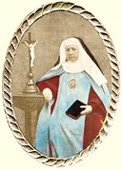
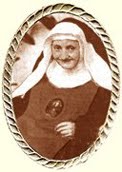
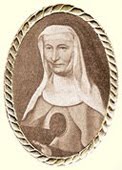
Mother Mary-Aloyse of the Immaculate Heart of Mary, O.SS.R. Superior of the Monastery of Bruges [2] (Brugge) 1822-1889

Chapter V.
Mother Mary-Aloyse is named Directress of the Noviciate (1852-1870).

The letter which we are about to cite was addressed to Mother Mary-Aloyse, Mistress of Novices: this responsibility was in fact entrusted to our modest heroine in 1852, and she exercised it until 1870.

Formed as she was in the school of Mother Mary-Philomena, and abundantly nourished on the instructions of the Rev. Father Passerat, Sister Mary-Aloyse also received from God the precious qualities which disposed her to government. Her practical sense was rare, her judgement excellent, and her knowledge of the spiritual ways permitted her to guide others along the path of perfection. The sweet teachings of St. Alphonsus also served her as a rule, and in the school of this great master, she had learnt to require nothing that was beyond the powers or the abilities of her disciples, but what she always firmly required was for everyone to avoid deliberate faults with the greatest care, to do penance for those which they had committed, and to apply themselves diligently to fulfil all the obligations imposed on them by the Rule. Effort, a care for detail, unhurried actions, these indispensable elements in tendency to perfection, were also the subject of her recommendations, but she wanted everything to be inspired, sustained and brought to a good end through the love of Jesus Christ. So she gave a soul to this body of sometimes meticulous practices which are called spiritual warfare, and a sure pledge of success to efforts that the lack of love condemns too often to powerlessness.

Let us hear her former novices themselves speak to us of some events in their noviciate.

“On the first Friday of each month,” one of them writes, “Sister Mary-Aloyse required her novices to put down in writing the accusation they proposed to make against themselves, so as to rectify it if possible. One day, when a novice brought her piece of paper to her, she noticed her mistress crossing out a sentence in which she accused herself of having wrongly judged her Superior, and of having said several words expressing criticism. So she permitted herself to ask her the reason for this, expressing her regret to her and the desire she had for repairing and expiating her fault. Sister Mary-Aloyse said to her, “This fault is so displeasing to Our Lord’s Heart that a novice must never commit it. Make Him a sincere promise that never again will you cause Him this pain, as whoever despises her Superiors wounds Him right to the Heart.” She imposed a small penance on the novice, who corrected herself, through the fear of causing pain to Jesus Christ Himself.”

“A novice experienced an antipathy towards a Sister whose manners upset her, and some of whose practices toward her were hurtful to her. It was the custom to beg for soup in the refectory. The novice found this penance agreeable, we might even say amusing, but she never managed to bring herself to do it, because the young Sisters had to give way to the older ones. Finally she succeeded one day in taking hold of the blessed dish that she had coveted for so long, and got ready most happily to go round the refectory on her knees to beg for her bread, when Sister N took the soup-plate out of her hands to do the penance in her place. - This trial was too much for the novice. She went and complained to the Mistress, not being able to suppress some disagreeable reflections about the Sister who had supplanted her. When she had finished venting her spleen, the Mother Mistress said to her: “My dear Sister, far too often you have noticed this and that in this fervent religious. Believe me, if you do not take care, you will nourish an antipathy inside you which will be a source of many imperfections for you. If you want to stop this right at the beginning, this is what you must do: every time when , for one cause or another, you feel a sense of discontentment against this good Sister, find an occasion to render her a service, or go up to her in recreation to say something nice to her.” The novice followed this advice and found it good, and applied it for the rest of her life to every Sister whom she did not like, and thanks to the good advice of her devoted Mistress, she managed, by repeated acts, to be able sometimes to quite set aside the dislikes she felt for the Sisters who beforehand seemed so disagreeable to her.

“A novice (it is the same Sister talking), a novice was often criticised for the attachment she had to her own will. On one of the monthly retreats, she wished to give her Mistress a surprise. She sent her a rosary case made of coconut wood, and told her, “Mother, this detachment is small, it is true, but it has cost me a great deal.” Sister Mary-Aloyse took the little box and opened it as they talked. The novice had put a little note inside it bearing the words: “My will.” The Mistress showed herself very satisfied, but added, “My Sister, do not forget this gift which you have just given me, and from time to time let me make use of it.”

Let us listen to some other accounts. Their style is quite different, but they are quite marvellous in letting us glimpse inside the noviciate of Bruges in 1861-62.

“The Reverend Mother Mary-Aloyse made us take our noviciate seriously, and ever since I have always blessed and thanked our good God, although, at the time, I found her very severe.

“In recreation, this Mother maintained the most frank cheerfulness. There were several of us French girls and two of them above all would often start talking, because, as they said, they would do anything to liven up the others. But one day, the Mother Mistress said to me, half seriously and half as a joke, “My dear Sister, I believe that if you were to spend a recreation without talking, you would do yourself a great deal of harm.” After this I replied bravely that I would try to do it from the next day on. The Mother Mistress gave a wry smile and agreed. The next day, while continually looking at Mother and the other Sisters, I kept a firm silence, as if was quite easy for me. So then she set herself to get me to talk, offering me whatever would tempt me the most, such as pictures, etc., but to my great satisfaction, the bell sounded before I could say anything. Then there was general laughter.

“Another time, while we were walking in the garden during recreation (it was in the month of November), we happened to walk near an apple-tree. I got very excited at the idea of the fruit that it would bear in the following year, but as our Mother had a better knowledge in practice of the virtues than of arboriculture, she had some doubts about my competence and said to me, “Oh well, Sister, mark the fruit buds with a bit of thread and then we will see the proof of your knowledge.”

“The following year, to my great satisfaction, the tree produced many fine buds, but then withered up entirely and died. I was most disappointed. Then my Mistress ordered me to water my apple-tree every day, which I did even among the snow and ice of a most severe winter. In Spring, divine Providence declared itself in my favour, and my apple-tree produced fine apples. It was given my name (Mary Augustine) in remembrance, and when I was sent on to the foundation of Velp, I still received fruit from my resuscitated apple-tree. It was my Mistress who brought them to me with great joy, and I ate them with great pleasure.”

These citations show Sister Mary-Aloyse as a Mistress who was concerned to advance all her charges in perfection. One of her letters will demonstrate this.

“Dear little Sister,” she wrote to one of her novices, “your good letter has pleased me greatly. Never let yourself be discouraged. Jesus is with you, and when you have worked with courage to prepare a place for Him, He will come to dwell in your heart. He is there already, but He will come in a more intimate manner, and just one of these moments will make you completely forget, or rather, bless all the days of struggling. So courage then! Everything will be well, I can assure you on behalf of Jesus, if you never cease struggling and above all, if you never let yourself be discouraged. I am very happy that you see yourself as ugly. It is a grace. Reply to it by redoubling your confidence in Him who loves you so much and who will make you beautiful, if you offer Him your hand by humbling yourself in confidence. Recollection will also come. Patience, patience. Nothing is done in one day, but you must not let a single day go by without working. You love our good God more than you believe. Bless Him for everything. It is for your own good! Good-by for now, but I shall be looking forward to seeing you again. I pray to Mary to bless you.
“Sister Mary-Aloyse.”

Velp, 24th September 1860...
Let the novices speak again.
Sister Mary Clementine, [11] from the convent of Dublin, pays tribute to the great virtues of Mother Mary Philomena, and adds:

“Regarding the good Mother Mary-Aloyse, Dear Mother, I can only say that as Mistress of Novices and as Superior, she was always an enlightened directress to me and a tender Mother, who preached equally by example and by word, and knew how to make us love our holy Rules and the practice of the religious virtues. In a word, in these two Mothers I have always venerated the archetype of true and worthy Redemptoristine Superiors.”

Sister Mary-Lidwine of the Holy Spirit [12] particularly praises the vigilance and energy of her former Mistress of Novices:

“Both of them, Mother Mary-Philomena and her were most zealous in making souls advance towards perfection and forming solid virtues in their nuns. The Mother Vicar, Sister Mary-Aloyse, was my Mistress of Novices for two years. She greatly edified me through her energy, courage and power of soul by which she made her novices advance, with her eyes and her ears always open to correct the faults which she saw in them.”

Mother Mary Gertrude, the Superior of Clapham (London), was only under the direction of Mother Mary-Aloyse for a few months. “From the first day that I knew her,” she says, “I had the greatest veneration for her. Her recollected exterior reminded me of her angelic Patron, and her air of recollection as she went through the Monastery was wonderful to see. When she was my Mistress of Novices, she was the perfect model of a religious, and through her words, which breathed the spirit of our Father Saint Alphonsus, she taught us never to recoil before any sacrifice when it touched on the good of the Order. She often told me. “You must remember that our good God wants you to be a saint. This is why you must suffer, and struggle, and love beyond all measure Him who has loved us so much.”

“To some of them she could seem severe, but this severity was due to her love of the holy Rule and our Father Saint Alphonsus. I have always heard it said that she was as simple as a little child towards her Superiors. My memory and my heart will forever retain the memory of her spirit of prayer, her fervent love for observance, and her angelic modesty. In a word, it is impossible for me to describe in their entirety the virtues that we venerate in our holy Mother Mistress, and I still love to talk to our young Sisters about her great qualities and her instructions, to encourage them to walk in the footsteps of those who have gone before us.”

Sister Mary-Magdalen of Jesus, a Redemptoristine of Dublin, renders this moving tribute to her former Mother Mistress.

“Obedience asks me to do something which I feel entirely incapable of, although I have an inexpressible desire to open my heart full of gratitude towards my former Mother Mistress, the Reverend Mother Mary-Aloyse. I was a novice under her orders for more than two years, and during this time, I venerated her like a saint, and this sentiment still remains with me and is still the same as it has been for almost forty eight years. For myself, I believe that she was the most perfect soul that I have ever known. As Mistress, she was strict, as a Mother she was full of tenderness, devotion and sacrifice. Her example was a stimulus to excite our fervour. When speaking of the little observances she would tell us, “What our Father Saint Alphonsus has prescribed for us is not too small for me to practise.” I will never forget her holy words and instructions. Dear Reverend Mother, you will excuse my initiative and my bad French. I hope you will understand me, but my affection for my beloved Mother will never change. I hope that in her heavenly home she will think of her former novice and pray for her. As my own turn is coming, I greatly hope for her prayers to obtain mercy for me from our good God, and a happy death, when it is His holy will.”

From Dublin, too, the following letter comes to us, with its own special charm:

“Your dear aunt [13] being from Liège, I was most curious to get to know her, and I observed her well.

“The Reverend Sister Mary-Aloyse has always been regarded as a holy religious. She had a very serious exterior, and she was very severe with herself, but indulgent towards others. She was a model of regular observance, and showed a great love of poverty and silence. She was also very mortified, but her dearest virtue was that of obedience. The Reverend Sister Mary-Aloyse had a remarkable love for this virtue. She would have liked to change everything into obedience.

“When she became our Mother Mistress of Novices, she seemed a little cold and distant, and we were somewhat afraid of her. In our case, that was just as well. She was very maternal. When we were suffering, she would spare nothing to comfort us.

“In recreation, she was very jolly. Sometimes we spoke in the Liège dialect, but she knew it better than me, and this amused her immensely. Sometimes I would say, “Come now, Mother Mistress, now I can tell you all my secrets in public, because none of the novices can understand a word.”

The good Mother was most eager to inspire us with a love of our vocation and the religious virtues. Later on, I learnt from one of my companions that she had become very affable, very loveable, and our dear Sister Mary-Clementine confirmed it to me. This is another tribute to her virtue, and I am persuaded that this was a fruit of her beloved obedience.

“Through humility she would never let us render her any service, and when we looked for an occasion, she tried to avoid us every time, always saying, “I am my own servant.”

“So, dear Reverend Mother, look what my poor pen has produced. I do not doubt that God and His angels knows all this even better than us, but heaven will reveal it all to us.”

Let us now add another letter to all of these. It is dated September 1905 like the preceding ones. The venerable signatory of it died two months after writing it. [14] What a wonderful sense of gratitude and filial affection is found in it!

“Dear Reverend Mother,
“It is not simply a pleasure, it is a duty for me to say some words about the virtues of our Mother Mary-Aloyse, who was my Mother Mistress in the Educandate and the Noviciate.

“This dear Mother was strict about everything concerning holy observance, and remarkably hard on herself, but she also showed a very maternal goodness towards those who addressed themselves to her. I have had this experience myself. Being naturally timid, I did not dare approach her, but as soon as I had overcome that childish fear, I found a mother’s heart in her, full of the spirit of our Father Saint Alphonsus, and seeking by all means that his spirit suggested to her, to inculcate into our young hearts the divine virtues that our divine Saviour had practised during His life, such as humility, simplicity, abnegation of self, and above everything else, holy poverty. This last virtue she practised herself with great perfection during her whole religious life, so that we could say that it was her favourite virtue.

“She recommended novices to always have a great respect for their religious costume, by keeping it clean and tidy.

“Although this good Mother was occupied all day with the task she was responsible for, when she arrived at recreation, she was always jolly like a young novice.

“May our good Jesus bless her soul in a special manner for having guided me and taught me to walk in the blessed way of holy religious life”

“Sister Maria-Angelica of the Most Holy Sacrament, Religious of the Most Holy Redeemer.”

Footnotes

[11] Died at Clapham (London) on 19th March 1907.
[12] Sent from Bruges to the foundation at Louvain in 1875.
[13] This letter is addressed, like its predecessors, to the Reverend Mother Superior of the Redemptoristines of Bruges, the niece of Mother Mary-Aloyse.
[14] She died at Dublin on 19th November following.


This necrology is translated from Fleurs de l'Institut des Rédemptoristines by Mr John R. Bradbury. The copyright of this translation is the property of the Redemptoristine Nuns of Maitland, Australia. The integral version of the translated book will be posted here as the necrologies appear.

Sunday, 5 June 2011

Mother Mary-Aloyse of the Immaculate Heart of Mary, O.SS.R. Superior of the Monastery of Bruges [2] (Brugge) 1822-1889

Chapter IV.
The Different Responsibilities Exercised by Sister Mary-Aloyse.
A spiritual director and the work of a soul.

Contemplative Orders are not Orders of dreamers, and those who would discredit them would be most astonished to see them doing different tasks and fulfilling different responsibilities that require great activity. A community of forty nuns requires to be well directed spiritually, and well regulated temporally. Both souls and bodies have their own needs, for which due provision must be made. Mother Superior, Mother Vicar, Mistress of Educands, Mistress of Novices, Sister Housekeeper, Sister Admonisher, Sister Dressmaker, Sister Sacristan, and many others. Oh, how many degrees there are in the peaceful hierarchy that we call the organisation of a convent!

Sister Mary-Aloyse very early drew the attention of her Superiors. Her talents, her virtues and her aptitudes promptly signalled her as capable of fulfilling the most difficult tasks.

She began with the modest task of sacristan. Father Paul Reyners, her director, would have liked her to join the Council as soon as she left the Noviciate. But the Rule opposed this, and the good Sister, when she discovered this, declared besides that she thought this was all a joke. Because she was capable in whatever she did, she taught the various tasks to the young Sisters. She had learned to paint. She made use of her talents to paint pious images. She made lace for the sacristy. She made reliquaries. This last work was so dear to her that she reserved it to herself, even when she became the Superior, and only her last illness was able to make her abandon it.

In 1853, she was entrusted with the important task of Mistress of Novices, which she exercised for the space of seventeen years. We shall speak of it later. To this task, in 1858, she added that of Mother Vicar, and from then on she became, we may say, the right arm of her worthy Superior, Mother Mary-Philomena, who for a long time had appreciated her virtues. She soon realised the wisdom of her advice, and never wished to make any important decision without consulting her. At the time of the foundation of Louvain, Sister Mary-Aloyse gave her already-suffering Superior the most devoted support, accompanying her on all her journeys, taking all the steps necessary to assure the foundation, and organising everything. Once all the preparations were complete, she left Bruges with the first Sisters, only returning when the ceremony of erecting the enclosure had brought the matter to its end. She still continued to give assistance from afar by her letters to the members of the new foundation. She also accompanied Mother Mary-Philomena on her last journey to Velp (1858). In a word, until the very day (12th January 1879) when she was elected as the Superior of Bruges, Sister Mary-Aloyse never ceased to render the greatest services in all the tasks that were entrusted to her. In these tasks, most exceptionally, she always performed in a manner pleasing to God and satisfactory to everyone involved.

This is perhaps the place to dispel certain misunderstandings on the subject of the spiritual direction of a soul, in placing before the eyes of our readers some letters addressed to Sister Mary-Aloyse by Father Theodore Kockerols, Redemptorist. We will see that this good Father’s direction contained nothing original or ambitious. It was as clear as light, as simple as a fine day, and it spoke at one and the same time to the soul of this good Sister and the soul of her director. We will give these letters regardless of dates, because they are unknown to us, including the year.

Antwerp, 25th....
“My daughter in Jesus Christ,
“Our Lady will give you better counsel than I can give you, but since it has been such a long time since I last talked to you, I think that you will hear me all the more willingly. Besides, if my advice does not agree with that of Our Lady, reject it out-of-hand (mine, of course, as you are simple enough not to understand me). Arm yourself with a holy anger against your own self, and be admirably sweet towards everyone. Be deaf to the voice of your own nature, and lend an attentive ear to every word that Our Lord will speak inside you.

“Be blind to the imperfections of the Sisters who are not entrusted to your care, and have eagle eyes to discover your own shortcomings. Do not listen to the devil, who will discourage you, but to the Lord who inspires confidence. Have more fear of the shadow of a voluntary fault than thousands of temptations, whatever they are.

“Above all else, love prayer, knowing that it is the beginning, the middle and the end of the spiritual life, for it is prayer which purifies the soul of its miseries, which gives it the strength to practise virtue, which detaches it from creatures and brings it to joy in the Lord.

“I wish you even greater graces, and tomorrow I shall pray for you to receive them to your heart’s desires.

“Wishing you everything in Jesus Christ,
“Theodore Kockerols.”

Brussels.
“My daughter in Jesus Christ,
“I recommend to you 1) your own conversion, 2) the conversion of the Reverend Mother, 1 and 3) my own conversion. Three great works of mercy.

“Take care to look into every corner, not of the Reverend Mother’s conscience, nor of my own, but of your own, - and be without mercy for the bears, the leopards and the bad subjects that you will find there. May our good Jesus expel them, striking them with His whip, and may He place a cherubim with a flaming sword at the entry, to prevent them from ever returning.

“Milk and honey run from the rocks,” it says in the Holy Scriptures. - When this becomes true for you, then my poor soul will leap for joy. But for as long as it does not please the Lord for this to be so, I will say with all the power of my soul: Patience, my daughter, patience! Jesus is so adorable and so good that if we have the happiness to find Him and contemplate Him for a single second after a hundred thousand years of seeking Him, then we ought to consider ourselves happy, ineffably happy. Jesus, good Jesus, show us just a little glimpse of Your beauty, and we shall be so faithful to You!

“Pray for the poor soul of him who wishes you to be entirely for Jesus Christ through His holy Mother.”

Here now are the thoughts inspired in Father Theodore by the Feast of St. Luis de Gonzaga, Sister Mary-Aloyse’s patron saint.

Brussels, 20th June.
“My daughter in Jesus Christ,
“If St. Luis de Gonzaga will obtain for you tomorrow the grace which I will be asking for you, then you will have good reason to be happy, like a bird in Paradise. And this grace? I shall have trouble in expressing myself so that you can understand me properly. In any case, it is not deliverance from either your bodily or spiritual miseries, - certainly not that! After some days of thinking particularly about you, I came to feel that misery is your fate, your second nature. So I do not wish for your misery to be taken away from you. God wants it, so take note. But I would dearly wish for you to be as docile as a child in God’s hands - and may you let yourself be annihilated when He intends it and as He intends it. Oh, how much I would like to see you unflinching under God’s hand, even when His hand is armed with the sharp sword of sorrows and humiliation! How much I would like to see you reduced to an atom of dust, but crying out forever and always in a loud voice, “Thank you, my God, thank you! I shall love You increasingly, the more You make me suffer more and more.”

“I can see that I am a little bit cruel in my wishes. I shall stop here, for I am almost at the point of wishing you to be nothing, and more than nothing in the superlative. But truly, you may believe me, I also wish very ardently for you to be great, very great, because you are totally in God.

“In your misery, pray for my misery.
“A happy Feast, Sister Mary-Aloyse, from your Father in Jesus Christ.”

The following letter is neither less well thought out or less well written than the preceding ones. It also reveals the good Sister’s tendency to worry too much in her desire for perfection and the religious virtues.

Brussels.
“My daughter in Jesus Christ,
I thank you for the goodness you have shown me in giving me the news about the Reverend Mother’s health. For the love of our little Jesus, do not let her depart, even though she wants it so much.

“In your letter you ask me when your heart will change. Truly, I thought you had more spirit. But it is changing every day, because every day it is becoming more unendurable to you. Is it not a sign that we are advancing in perfection, when we detest our imperfections and sigh for the moment when there are no more in our souls? In your opinion, apparently, this moment is too long in coming. But the Lord, who knows you better than you know yourself, knows very well that you would send yourself to your destruction if He let this long-desired moment come too soon. You sigh after humility, and I know that your sighs are sincere. So have patience, and let the Lord be responsible for teaching you humility. If He does not do so, what will happen? We often laugh about the little humiliations in the cloister - at the very least they just scratch the skin. But God’s sting us deeply and hurt greatly. I shall pray that this operation will not be too long, and that you will be able to endure it in all patience.”

“Your servant in Jesus Christ.”

A last missive from the good Father Theodore will worthily crown these admirable letters. Of all of them, this is perhaps the most instructive.

Brussels, 30th May 1862.
“My daughter in Jesus Christ,
“In the name of the Reverend Mother, you ask for a death-blow to the activity of your own nature, and certainly, if it depended on me, I would not fail to give it to you. But, but, it is difficult enough to kill an eel by hitting it with a stick. And it is even more difficult to calm down with a whip a heart that is too ardent and in too much of a hurry. Because He wishes to preserve us from every fault and every imperfection, Our Lord Jesus Christ has said, Vigilate - “Be watchful!” ... This advice is perfect for protecting ourselves against all sorts of temptations and weaknesses. But according to the opinion of all the Saints, it is the only indispensable and efficacious advice against the rushing of the heart. At every instant of the day, in a large community, - and a fortiori - “even more strongly”, in the pleasant task of Mistress of Novices, our hearts are exposed to a thousand little enthusiasms, a thousand and one agitations which often reach us this way , especially when we wish to raise everything to the peak of perfection in everything that surrounds us. So she who does not exercise a continual vigilance against all the movements of her heart, to repress them as soon as they depart from the strict rules of meekness and charity, will be like a reed exposed to all the winds, and who is never for a single instant in a perfect calm. Vigilance, - see the whip here. - And the less elegant stick? A generous violence and continual efforts, without listening to the demands of our own self-esteem.

“I perceive that I am dealing with this matter almost seriously, like a doctor. Forgive me and do what I tell you, and you will be a living reliquary You need a great mirror, but I am sure that the Reverend Mother will be happy to buy one for you.

“As for the other miseries that you tell me are so horrible, I am sorry for you, I could almost say that I have pity for you, but I will not say even one “Hail Mary” to deliver you from them. I have the deep conviction that this is a work of God whose final aim is to purify your heart, to make you capable of a closer union with Him. What a strange manner, you tell me, to purify a heart! - In fact it is strange, but you can be sure that it is a good one, because God is using it - God, who is so jealous of the purity of heart of His Spouses. Patience, - that is the whip. - Abandon yourself without a whimper to the will of God, for this is the stick which will knock out your self-esteem, which does not know how to resign itself to this apparent ugliness.

“Now you know what you must do to attract the Holy Spirit and the fullness of His gifts into your heart. So banish every trouble and agitation, and you will feel His presence in the midst of this perfect silencing of your passions. Abandon yourself to the divine will, and thank this divine will for all the distressing things which have happened to you. The fire which seems to come out from all this apparent unpleasantness will purify you. What more is needed to make your heart pure and of good will, and fit to enter into God?

“Pray for the poor soul of your servant in Jesus Christ.”

This necrology is translated from Fleurs de l'Institut des Rédemptoristines by Mr John R. Bradbury. The copyright of this translation is the property of the Redemptoristine Nuns of Maitland, Australia. The integral version of the translated book will be posted here as the necrologies appear.

Sunday, 29 May 2011

Mother Mary-Aloyse of the Immaculate Heart of Mary, O.SS.R. Superior of the Monastery of Bruges [2] (Brugge) 1822-1889

Chapter III.
The Monastery of Bruges. - Father Passerat and his Conferences (1846-1850).

Let us now get to know a little bit about this Monastery of Bruges (Brugge) where the life of Mother Mary-Aloyse was spent. There are many things about it which will attract our interest.

The foundress was Mother Mary-Alphonsus of the Will of God, who came from Austria with her devoted friend, Sister Mary-Gabrielle of the Most Holy Trinity. When she arrived at Bruges, six choir Postulants and three converse entered. On 23rd March 1843, seven choir sisters made their profession before Monsignor Boussen, the Bishop of Brussels. Trials were not lacking. The house was only provisional, but everyone’s courage was marvellously sustained. Encouraged by frequent letters from the Venerable Father Passerat, Mother Mary-Alphonsus marched bravely at the head of all her sisters, and gave an example of the finest virtues in every respect. Her holy director gives us testimony of it: “Bruges,” he wrote, “will be the flower of the Order, above all in virtues, as I am learning from different sources.” He was invited to come to Bruges. He replied: “Have no doubt that I will do everything that depends on me to come and see you; but, my God, I am certainly not the Messiah, either for you or for your dear educands.” And besides, if the good Father’s words were not kind enough, his lessons were no less worthy of study, as we find witnessed in this letter dated from the end of January 1844, and which our Sister Mary-Aloyse was doubtless familiar with:

“Since you are such good soil, which knows how to make each crop bear fruit, may I be permitted to teach you how to lead the life of Methuselah, even here below.

“How is this to be done? - Be most observant of your holy Rules and Constitutions, and suffer the martyrdom of community life with courage and in a spirit of love; through this you will preserve your Order in its proper fervour until the end of the world.”

Father Passerat was then most concerned to recommend them to flee every deliberate venial sin like death, and concluded with these words. “And so, dear Sisters, fear your little aversions and affections, your slowness to rise in the morning from your beds and be ready for community tasks at the first sound of the bell. Fear this excessive care for your health, your little impatiences, your faults against exterior silence, and especially interior silence, your judgements, no matter how evident may seem the faults that you see; fear all those holy nuances which we know how to give the evil that our hearts desire. Fear, fear... fear as a mortal sin every deliberate venial sin. No deliberate faults at all... none at all, not one. I urgently demand this grace from Jesus Christ through the most holy Heart of Mary for you and for me.” [8]

A year later and Father Passerat came to Bruges in person. The new Redemptoristine convent was finished, and only the chapel remained to be completed. Nonetheless they wished to transfer the community to it new abode. It was on 23rd June 1845, on the stroke of four o’clock in the morning and to the chant of the Benedictus, that the Sisters took possession of their Monastery. The Redemptoristines still remember that admirable scene. The Most Reverend Father Passerat carried the Blessed Sacrament, Mother Mary-Alphonsus and the nuns accompanied her bearing lighted candles. The procession made its way through the cloisters, and finally the holy sacrifice was offered for the first time in the little sanctuary. “The feast lasted three days,” said the Annalist. On 25th June, Mons. Corselis, the Vicar-General, came to bless the Monastery. The following day, His Grace, Mons. Boussen, our Bishop, established the enclosure with great solemnity. The construction of the church was only completed in 1847. On that occasion, the bells were blessed by His Lordship, who himself deigned to open our little church for public worship.”

However, the Revolution of 1848 burst upon them at this time. The Redemptorists fled Vienna and took refuge in America, but four Redemptoristine Sisters came to ask for refuge with their Sisters of Bruges. [9] As for the Most Reverend Father Passerat, he established himself in this town near the Monastery of the nuns. For two years (from 13th September 1848 to 3rd September 1850) he dispensed to them the treasures of his wisdom and his direction.

The advice which he gave Sister Mary-Aloyse is a good indication of the kind of spiritual life inculcated by this Servant of God. It is edifying to see the care with which he attributes everything to Jesus Christ.

“Love Jesus Christ with all your heart,” he tells her, “and retain your affection for His Passion, base all your meditations on it, and aspire to the first place in heaven through your love for Jesus Christ.

“When you suffer and you are prevented from every mortification, remember that in suffering you are praying, you are fasting, and you are fulfilling your whole Rule. This is indeed your mortification. Do not listen to your own nature, which always tells you to descend from the cross. It is a false traitor, and you must not listen to it. Think often of Jesus Christ as you think in the world of a person you love, but think even more of Him who merits it more than any person in the world.

“In your life, unite everything to Jesus Christ. If you suffer, think first of all of Him, and then take the consolation that He gives you. Begin everything in Jesus Christ, and finish everything in Jesus Christ.

“What you must ask of God first of all is courage.

“What is the interior life? It is the life of faith, hope and charity.

“In your meditations, do not think too much; this is how you will obtain the most grace for yourself and others. Love, and do acts of love and gratitude. Do not go so much by the letter of what you read, but let yourself be moved by your affections.

“Be always happy and content. Never reason with the devil, and quickly chase away every sad and troublesome thought. Do not afflict yourself in your temptations.

“Desire to suffer for Jesus Christ. When you suffer interiorly or exteriorly, offer yourself to Jesus Christ to suffer so even until the Day of Judgement if this is His holy will. Unite everything to Jesus Christ: your thoughts, your words, your work, your prayers, your sufferings, and everything.”

This wise and firm direction bore its fruits. Mother Mary-Aloyse was always distinguished by her close union with Jesus and Mary, by the great care which she showed in her actions, by her attention to sanctifying her least sufferings. This fervent professed thus drew great profit from the lessons of her Noviciate. In her conduct towards her neighbour she was always seen to be full of candour and frankness in regard to her Superiors, and most circumspect in regard to her Sisters, and charitable towards them by never judging them, nor criticising them, nor inquiring into their conduct.

Is it not due to this that that we may now apply the promises that she made later to one of her novices:

“In following these counsels, you will be truly happy, as you will enjoy the peace and joy of a good conscience; and when you see the day when you will have to render your account to Our Lord, you will see it arrive without fear and even with joy, as you will be able to say, “Lord Jesus, it is for You that I have lived, have struggled, and have triumphed over myself. It is for You that I wish to die, so as to reunite myself with You forever.” Then you will not regret having reined in your tongue, tamed your character, put a brake on your spirit, and contradicted your heart, because you understand that anything which is not God is nothing.

“May Jesus be all for you. Tell all your troubles to this good and adorable Saviour, and to Mary, his good Mother and your own. They have such compassionate hearts. They will understand you, encourage you, help you and strengthen you.

“Go on ahead before God, remembering that after your death, your good or your bad examples will alone survive you, and do not worry about the conduct of others. For in examining and judging other, you will forget your own shortcomings and fall into pride.”

Footnotes

[8] Souvenirs (Memorials), published by Father Nimal, Redemptorist, 1 vol., p. 128, Liège, Dessain - Paris, Magnin.
[9] These were: in 1848, Sister M. Cherubim who became the Superior at Velp in 1858; - in 1849, Sister Mary-Baptist. She died eight months later, attended by Father Passerat; - in 1850, Sister Mary Fidelis, the granddaughter of Countess Welsersheimb. She left Bruges in 1852 to go to the foundation of Ried. - A converse sister, Sister Alphonsa, had accompanied Sister M. Fidelis to Bruges. Several months later, on 17th January 1851, she went to Galoppe where several Redemptoristines had gathered, waiting for the convent at Marienthal to be finished.

This necrology is translated from Fleurs de l'Institut des Rédemptoristines by Mr John R. Bradbury. The copyright of this translation is the property of the Redemptoristine Nuns of Maitland, Australia. The integral version of the translated book will be posted here as the necrologies appear.

Sunday, 22 May 2011

Mother Mary-Aloyse of the Immaculate Heart of Mary, O.SS.R. Superior of the Monastery of Bruges [2] (Brugge) 1822-1889

Chapter II.
The Educand. - The Novice (1844-1846).

The house which welcomed the new arrival was no more than a provisional convent, occupied for the last two and a half years by the Redemptoristines, but in a state of dilapidation which they had scarcely been able to remedy. As Mother Mary-Aloyse was to write later on, “It was no more than an old house which let the cold and the wind enter through ill-fitting windows. Everything was freezing, even beside the fire, and the Sisters had nothing which could guarantee them against the worst of the weather.” But the Postulant, avid for sufferings and sacrifices, resolutely embraced this new life. Was she not happy to prove right from the beginning her love for Him who had called her there? The convent was small and cramped. It was but the little house, as it was to be called later on. The Monastery was under construction elsewhere, and this building work was absorbing all their resources. So poverty made its rigours felt, and the necessities were often lacking. But the Postulant never said a word to her family which could have led them to suspect anything. And she who was so used to the fresh country air, could only go and walk in the courtyard for ten minutes or so at midday. She slept at ground floor level in a paved room, in common with the other Educands. In brief, her privations were numerous.

The Postulant also quickly came to know temptations. Father Dechamps had predicted it, and in a letter dated 15th January 1844 from Liège, he wrote to her:

“My daughter in Jesus Christ,
“In war as in war, but you are quite astonished to be a soldier, aren’t you? The greatest enemy is he who throws dust in your eyes and who blurs your sight, the Father of Lies. What matters is go and tell your dear Superiors straight away all the stories he has put in your head. For example, the thought has been given to you with an evil intention that your parents will perhaps be left alone, that you will not be able to cope with this kind of life, etc. You see how wicked he is. He attacks you through fear, through tenderness and even through scruples, and then he make you afraid to ask any of those who are visible Providence to you what you ought to ask. - Courage! Find your weapons! Even to taking up a brush! - I used to know a religious, Father Villani [4] who received some very great graces through a brush .. when polishing his shoes. He didn’t exactly tell me, but I saw it and guessed it. I saw what happened. Sometimes he would polish some of his colleagues shoes, thinking all the time of the words of St. John the Baptist, 'I am not worthy, etc.'

“I am not surprised to hear that you are content with your pains. Jesus Christ is in the citadel when your enemies make a din in all the rest of the place. It is certainly consoling for you to take the place, so clearly and so providentially, of this good nun [5] who is already with St. Alphonsus, where she can show you to her Father, so that He may draw you to Himself.

“'But the virtues?' you will say. Patience, for they are bought little by little. But where do you begin? With simple observance. 'Think of me,' Our Lord said to St. Catherine of Siena, 'and I will think of you.' So leave Him to look after you.

“Everything is quite calm at home...
“As for the news-vendors, I hear nothing from here. Who knows if they are talking about you at Liège? A bit here and there, and then they’re off to the ball, the show, etc. The world is nothing.

“I pray to Saint Alénie [6] to make you love the dear little martyrdom of religious life more and more.”

This consoling letter was followed some time later by a missive from Father Manvuisse, our Postulant’s first director. What could be more interesting than to be present at her first steps in religious life, sustained by exhortations of these valiant servants of God!

Tournai, 20th.
“You have given me great pleasure by your letter, my dear child. I have been awaiting this missive for a long time! Actually, I congratulate you not so much for the triumph that you have obtained over all the difficulties that have faced you in your entry into religion, but regarding your other successes, no less important, that your letter proves, and these are the dispositions that you have. How happy I am that the first difficulties have now been overcome, and that you are facing the others quite cheerfully! Yes, no doubt convent life is a little different from that of the world and the spirit of the one is quite opposed to that of the other! A similar difference with the customs! Certainly your father would shout out aloud for joy if he knew that his daughter was subjected to the little trials of the refectory and so many others... But in actual fact, is there anything so dreadful about it, even for your self-esteem? When you have once committed yourself bravely, then the die is cast. Then you always experience a certain advantage, although it costs less, because you never become quite as proud again as you were before you abased yourself. Certainly the holy founders of Orders thought out things well.

“You are afraid in advance, my dear child, of the communications which you are to make to your future Mistress of Novices. Believe me, sufficient to each day is the evil thereof. When the time comes to open your heart, you will ask for strength and courage for it, and God will grant it to you. He gives everything you require to fulfil the duties that He imposes. Do not alarm yourself in advance. Didn’t you also have to change directors when you were in the world?

“And then, my daughter, try to keep up a brave face before your father when he comes to see you! Show yourself firm and do not speak of these trifling little humiliations or privations which you have to suffer in the convent. It is not worthwhile. Certainly the people of the world have many other things to gossip about!

“So then, courage, courage! Let us not recoil before various trials and even certain sacrifices. God sees and counts up everything, so as to reward you for everything.

“Farewell, my dear child. I bless you with all my soul.”
“Manvuisse, C. SS. R.”

Thus encouraged, Sister Mary-Aloyse set herself bravely to the task. If her energetic soul was at its ease from the first moments when she was in the midst of her privations, she was no less so in declaring war against her natural inclinations. A tendency to worry stemming from a certain eagerness for perfection and sanctity, perhaps a slight tendency to sarcasm, a liveliness which stemmed from her energetic temperament and which never admitted half-measures, were, we believe, the object of her struggles. But she was not lacking in courage. Based on her humble defiance of her own self, it was to work miracles.

Moreover, in this respect she found a solid support in the person of Mother Mary-Philomena of the Divine Providence, her Mistress of Educands. This excellent religious, a model of affability and fervour, brought along in her footsteps all those of whom she had charge. What better way to make her known than by citing the letter addressed by her later on to one of her subordinates?

“Dear Sister M.., you have asked me for some lines of consolation. Here is my reply. Before all else, dear child, I wish you to have courage. Even before the invention of the railways, St. Teresa said that with courage we could go at a hundred miles per hour. So courage is therefore the electric telegraph of the spiritual life. And why go on foot or in a stage-coach, when there is the railway or the telegraph at your disposal? I see that you still retain a trace of your long-time infirmity Discouragement. The Prince of Darkness tries to profit from it. Send him packing. Besides, you should never be discouraged or surprised when you see you are still imperfect. We do not become saints in a day, and God is pleased to leave us a feeble and vulnerable side so that we may constantly be humble and feel the enormous need that we have of Him! In your temptations, never think of the temptation, but of Jesus Christ and Mary, and in general, when your spirit wishes to dream and reflect and examine things, keep your eyes fixed cheerfully on the adorable image of Jesus Christ who is in you, [7] and his holy Mother who is beside you. You will find in them what you should dream about for all eternity.”

As it turned out, the good Mother Mary-Philomena never allowed either the educands or the novices placed under her direction time to dream. She led them sweetly, but firmly to the practice of solid virtues. One of her former subjects depicts this wonderfully: “Always pleasant and smiling to everyone, you could not meet up with her (if you were feeling out of sorts) without seeing your pain vanish. When you looked at her, because of her amiability, everything disappeared and changed for the better, as if an angel had suddenly appeared and chased all the demons away. She made the souls of her children pass through the thorns of great trials, according to the special needs of each one of them. She sometimes said to me, right at the beginning, “Don’t be one of those religious who need to be handled with kid gloves.”

Sister Mary-Aloyse was never one of these last. Her ideal, when she entered the Order, had been to consecrate herself entirely to Jesus Christ through the immolation of her own will, tastes and inclinations. She pursued it unswervingly, in spite of temptations and dislikes of every sort. “My God,” she writes about this time, “I wish to repair the past. What You ask of me is more than recollection, modesty, maintaining my religion, saying less mundane things in recreation, less concern with my own well-being, more affability and evenness of temper towards my Sisters; no longer permitting myself to be sarcastic, and no longer seeking to draw attention to myself.” So much for the correction of her faults. Now let us hear what she says about her own personal sanctity. “Oh my God, let me hide myself in You. I wish to suffer and be despised for You. Oh Jesus. Beginning from today, let me be converted seriously. No more sins, my God, for I have already offended You too much. Mary, my Mother, help me to imitate St. Luis de Gonzaga. To inspire myself to observance, I often think that Jesus Christ wanted to suffer and be tormented for love of me. Come, my soul, courage! In a short time to come, we must merit heaven. Let us suffer cheerfully for God. A suffering discovered is one pearl less in your crown. Long live Jesus! I wish to suffer and overcome myself. The more pain, the more merit!”

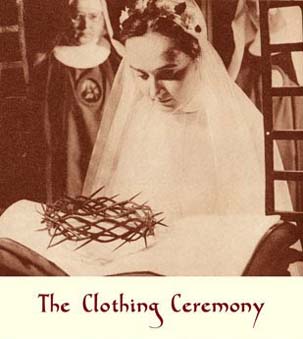
The pious educande took the habit on 6th January 1845. She received the name of Sister Mary-Aloyse of the Immaculate Heart of Mary. Her companion, Miss Mary Peters of Boxmeer (Holland), received the name of Sister Mary Scholastica of the Precious Blood. Mons. Corselis, the Vicar-General, officiated, and Rev. Father Paul Reyners gave a short address. Her mother and sister attended the ceremony. Her father came on his own later to pay her a visit. On the advice of Father Dechamps, Sister Mary-Aloyse of the Immaculate Heart of Mary had written him a sort “of letter of honourable satisfaction to paternal authority.” As she wrote in it of her pious director, her father, who was a Christian but too exclusively human “had good reason to believe” in his opposition. And she added, “it is not the contradictions which come from naughty children which is a great cross, but those that come from good ones. It was certainly to give you an occasion to practise patience, resignation and fidelity that God permitted so good a Christian to adhere to so false a point of view.” But everything ended in peace. Mr. Fabri finally understood that he had no more to dispute with God over his child, and so she was able, with joy in her heart and in concert with Sister Mary-Scholastica, to make her religious profession on 23rd January 1846. It was Mons. Boussen, the Bishop of Bruges (Brugge), who conducted the ceremony and Mons. Jacquemotte who made the usual speech. He highlighted the advantages, the obligations, and the rewards of the new life to which the two novices had been forever consecrated.

Footnotes

[4] Canon Villain, from the Diocese of Tournai, entered the Congregation of the Most Holy Redeemer on 18th July 1835. He died at Saint-Trond in an odour of sanctity on 30th January 1838. He took the name of Father Villani in memory of the famous Father of this name, who was one of St. Alphonsus’ first companions.
[5] Sister Mary-Aloyse, who died on 23rd December 1843.
[6] St. Alénie, martyr in the Forest of Brabant (7th Century). Her relics are in the main altar of the church of the Redemptorist Fathers at Liège. When these relics were moved into the Fathers’ church, Father Dechamps published a little brochure to make this Saint more widely known.
[7] Christum habere per fidem in cordibus vestris. - St. Paul (To have Christ through faith in your hearts.)

This necrology is translated from Fleurs de l'Institut des Rédemptoristines by Mr John R. Bradbury. The copyright of this translation is the property of the Redemptoristine Nuns of Maitland, Australia. The integral version of the translated book will be posted here as the necrologies appear.

Wednesday, 22 December 2010

Mother Mary-Aloyse of the Immaculate Heart of Mary, O.SS.R. Superior of the Monastery of Bruges [2] (Brugge) 1822-1889

Chapter I.
Miss Fabri in the world. - Her vocation at the Redemptoristine Institute (1822-1844)

The Reverend Mother Mary-Aloyse of the Immaculate Heart of Mary, in the world Miss Isabelle-Fulvie-Albertine Fabri, was born on 22nd October 1822 at Sény, a village situated in the county of Nandrin in Condroye, in the Province of Liège. Her father was Mr. Arsène-Henri-Joseph Fabri; her mother was Marie-Agnès-Joséphine de Longrée. They dwelt in the countryside for a great part of the year and spent the winter months at Liège. Until 1830, Mr. Fabri was a member of the States-General. Fulvie was the youngest of six children, four boys and two girls. She was the family favourite, and, as she said later on, even somewhat spoiled by her mother, who by nature was rather strict and severe. From her childhood, she was favoured by extraordinary graces, which through her humility however, she would never explain clearly. When little children came and asked her for alms, she would first make them recite the “Our Father”; but as she herself did not know it in Walloon, she would call the girl from the poultry yard and get her to tell her if they knew it properly. Her parents were very pious, but also very demanding in matters of religion. When their daughters had been to Mass, they had to spend the whole day in recollection and were not allowed to look at themselves in a mirror. Fulvie received her education in the paternal home and never left it before she entered religion. From the time they were first capable, she and her sister took care of the sacristy in the village church. Dressing the statue of the Virgin Most Holy, looking after the sacred ornaments, and tending the lamp of the Holy Sacrament were all her favourite occupations. On Sundays, she would go to the church at daybreak to take communion, would let herself be locked in to dialogue alone with her God, while the village priest would go off and celebrate holy Mass in the neighbouring hamlet. While she was still very young, she felt herself called to religious life. Her brother was preparing to join the Redemptorist Fathers, and had received the Life of St. Alphonsus as a gift from them. Fulvie found it, read it, and fixed her choice irrevocably. She would be a Redemptoristine, and go, if it was necessary to receive this happiness, even to Vienna, the cradle of the Order beyond the Alps. How great was her joy, then, when she learnt that Mother Mary-Alphonsus of the Will of God had come to found the convent of Bruges, aided in this great enterprise by the Most Reverend Father Passerat! Mr. Fabri, although a good and fervent Catholic, was strongly opposed to his daughter’s vocation. He was advanced in age, and Bruges was so far from Liège! How could he make such a long journey? On the other hand, Mons. Van Bommel had just founded the Daughters of the Cross at Liège. With Mr. Fabri’s permission, he did everything possible to persuade the pious young girl to enter this Order, which was devoted to teaching and works of mercy, “And one day”, he said, “you’ll be the Superior there.” Mother Mary-Aloyse said later on, “It was precisely this which prevented me from entering.” To test her vocation, her father, who greatly loved his social life and spent all his evenings playing cards when he was in town, required her to accompany him to his meetings. She went along to satisfy him, but did everything possible not to be pleasing to the world. In spite of her outgoing character she even went as far as maintaining an almost complete silence. Her confessor, the Rev. Father Manvuisse, required her to dress plainly. Her mother, however, soon realised this and would inspect her closely to make sure that everything was in order. But then, at the very moment she was to enter her carriage, the young girl, pretending that she had forgotten something, would go back up to her room and hurriedly pick up dark gloves, a linen kerchief, or something else of this kind. As for going to a ball, she never knew it. When Father Manvuisse left Liège, Miss Fulvie came under the direction of the Rev. Father Dechamps. This holy religious, later a Cardinal, helped her greatly to overcome the obstacles that the affections of her parents placed in he way. This can be seen from the following letters:
1843.
“My daughter in Jesus Christ, “Yes, come on Thursday or Friday. When you are sad and confused, you should open your heart and seek advice. While you are waiting, offer up your sorrows to Jesus Christ. It is the money marked with the sign of the cross. It is this which leads to heaven, and which alone pays for the great treasure that you desire. The most holy and Immaculate Heart of Mary is for you. Do not let yourself be worried. “If your dear father promises to say “Yes” after mother, it is because he counts, no doubt, on having his own way. However, speak about it to your dear mother. There is no reason to say nothing to her about it. I am not annoyed that your father wants to speak to me on his own. Then he will be even more convinced that I am speaking with full certainty. “As you already have a rule of life, I shall limit myself to giving you some advice. “You must make a particular examination of your confidence in God. Confidence in troubles, - confidence among temptations, - confidence in persistently finding obstacles to achieving your good desires. “Be keen to do the will of God in the multitude of little things and He will do your will. If He is slow to do it, it is so that it will be even more worthy of Him. “I promise you I will adhere closely to this divine will. So as to judge you properly, I have to come to know you not just exteriorly, but interiorly too. Those who do not know everything can give you advice in good faith which runs contrary to the internal attraction to which your reason and Faith are responding. But I have no fear in saying that, if they do not recognise a genuine vocation in your desire, motivated and sustained for more than four years for the Community which the spirit of St. Alphonsus inspires, then they are deceiving themselves. Your exterior dispositions accord well with this Institute. It is very fervent, - and God has given you an affection for its holy Founder and the grace to enjoy its spirit. - It is enough for me to tell you this in writing, so that you can show it to whoever is entitled to see it, in case of need. But you must overcome the obstacles with patience and meekness.” The second letter expresses the same thought more deeply, and replies to another objection.
1843.
“My daughter in Christ, “You should not be afraid of being examined by the Vicar-General [2] about the matter of your vocation. No doubt God permits that sometimes one person says one thing and another person another. But it is also important for us to discern His will and feel the interior action of His grace, when it is manifested by the way of obedience. We must never lose sight of the fact that a vocation is a matter of interior grace, and that this can only be discerned by those who know you profoundly. “I hope that the Vicar-General will share my opinion. We could say, I am sure, that Redemptorists would naturally be in favour of the convent of which St. Alphonsus is the Father. - But it would be a mistake to assume this. - As for those persons who turned to me on matters of vocation, I have sent only one on to Bruges, and many others elsewhere: to the Ladies of Christian Instruction, to the Sisters of Our Lady, to the Daughters of the Cross, to the Carmelites, the Poor Clares, the Daughters of St. Joseph, etc., and I have sent an even greater number back to their families. My colleagues have all done the same. “If I have told you that you would do best to go to Bruges, it is because your dispositions and the character of that Institute have convinced me. If you go there you will still have your pains and your crosses, but so does everyone else. What matters is how you bear your own cross. “In Jesus and Mary,
V. Dechamps, C. SS. R.”

Miss Fabri had revealed her temptations and apprehensions to her director. He wrote back to her:

23rd September 1843.
“Your last letter would have been very pleasing to God, because you say openly what is happening in your soul. Yes, it is always good to say it, even when it is past, and so much past that it would be hard to believe that you were ever disturbed by these sorts of fears or thoughts. Now that you have admitted it, may God give you His graces not to give in to all these apprehensions that have the power to crucify us. “You are not at the end of your troubles. “He who loves his father, mother, brothers and sisters more than Me is not worthy of Me.” But, my Saviour, surely You don’t ask everyone to make this sacrifice? - No, only those whom I love with a predilective love. Are you upset about being loved like this? This divine favour costs a great deal, so, as Madame Louise says, “Do not think about what it costs, but about what it is worth.” Then you will also have the inestimable happiness of no longer depending on your imagination and your own ideas, and you will always be able to say: “Now I only do what pleases Jesus Christ.” This is the freedom given to the children of God. “Fine sermons and fine services are good, especially for those who travel through the world dazzled by their own vanity, and who need to find God somewhere where their natural lives have not been absolutely crucified, but only directed towards a legitimate end. When you have left the world, you need this sort of help. And then God comes in solitude and silence. And when He hides Himself, you seek after Him, asking Him, “Even though You hide Your face from me until my death, I shall not leave You.” Life is short and is not intended for pleasure, but for trouble and work. “A little longer and You shall see Me”, says Our Lord. “Confidence and patience, patience and confidence, and a prayer for “Your most devoted servant in Jesus Christ,
“V. Dechamps.”

Another time he wrote to her, “You will be a nun for sure, unless God takes you for His great convent where He Himself vests you in glory. I criticise you only for your lack of abandonment, confidence and hope. When you are unable to meditate, pick up your rosary beads and say acts of hope like you say the “Hail Marys”: “My God, I hope for heaven and the way that brings me there, through the infinite merits of Jesus Christ and prayers of the Most Sacred Heart of Mary.” Hope, Hope, and the assurance of God’s protection. Do not believe your own dark thoughts. Our good God always loves you intensely. We must hold firm to what He has promised.
“Please remember me to all your dear and worthy family.” Things turned out as Father Dechamps had predicted, but “the great war of the vocation”, as he called it, could not be avoided, and it was at the price of some fierce battles that Miss Fabri finally won her father’s half-consent. She was then 21 years old. On 1st January 1844, her eldest brother arrived unexpectedly in Liège to take her to Bruges. She had to make her preparations for her departure in some haste. That evening she went to kiss her brother, the lawyer, good-bye and the following morning at 6 o’clock she bid her parents a final farewell. On her way she paid a last visit to one of her maternal uncles, and towards evening she arrived at Bruges. Following the custom of those days, she made a visit to the Bishop of Bruges, Mons. Boussen, to present herself. He asked her if she had obtained the consent of her parents. “Half, Your Lordship” replied her brother. “Oh well,” said the Bishop, “when that’s all you can have, you have to be satisfied with it.” A short while later and Miss Fabri was knocking on the door of the Redemptoristine Monastery.

Footnotes

[2] This Monastery was founded in 1844. All the details of this foundation can be read in the book called: Une Rédemptoristine. - Mère Marie-Alphonse de la Volonté de Dieu, fondatrice des premiers monastères des Rédemptoristines en-deçà des Alpes. - Souvenirs publiés par le P. Nimal, rédemptoriste. (A Redemptoristine. - Mother Mary-Alphonsus of the Will of God, the foundress of the first Redemptoristine Monasteries beyond the Alps. - Memorials published by Father Nimal, Redemptorist. (1 vol., Liège, Dessain, Paris, Ve Magnin).
We cannot mention this venerable nun without paying tribute here to her blessed memory. It was her, in fact, as Cardinal Dechamps has said, whom God made use of to make the Redemptoristine Institute known beyond the Alps. She was born at Lorient in 1793, she moved to Vienna in 1820, and in 1830 went to St. Agatha of the Goths to find the Redemptoristine Rule. She received the habit of her Institute at Rome from the hands of Cardinal Odescalchi, built the Monastery of Vienna and founded the Monastery of Bruges in 1841. She died at Malines in an odour of sanctity on 29th March 1869. She was a faithful disciple of the Venerable Father Joseph Passerat, and communicated to her daughters the esteem which this great servant of God professed for St. Alphonsus’ wonderful books.
[3] Father Jacquemotte, the Vicar-General of Liège, and family friend.

This necrology is translated from Fleurs de l'Institut des Rédemptoristines by Mr John R. Bradbury. The copyright of this translation is the property of the Redemptoristine Nuns of Maitland, Australia. The integral version of the translated book
will be posted here as the necrologies appear.

Monday, 12 July 2010

Sr Marie Madeleine of Jesus Host, O.SS.R. (1868-1933)

Sr Marie Madeleine was born at Poperinghe, Flanders, on 2 June, 1868. She was baptised Helen Marie Cornelia Coevoet. Entering the Redemptoristine Order she received her religious name which may seem a little odd to English speaking readers, but the name "Jesus Host" is reasonably commonly given to French nuns in honour of the Eucharistic Jesus. She died piously at the Redemptoristine Convent of Bruges in the 33rd year of her monastic life on 11 March, 1933. †
(From Sister's mortuary card.)

The Servant of God Mother Marie Gabrielle of the Most Holy Trinity, O.SS.R. (1808-1868)

Redemptoristine of the Monastery of Malines

Maria Victoria Eder was born on 22 December, 1808, in Vähring, near Vienna, Austria. While still young she had a pronounced, even though innocent taste for apparel. One day, her mother having refused to garland her hair with roses, she went off in a fit of tears. The Redemptorist St Clement Mary Hofbauer having heard about this said to her: “Come on, don’t cry any more my child, you will soon receive a crown of roses from me.” The next day she better understood the lesson when she received a rosary from the saint. And in fact from that time on she bade farewell to the vanities of the world and gave herself up to piety. On the advise of St Clement she accepted the position of lady-in-waiting to Princess Poniatowska, grand-daughter of King Stanislaus Poniatowski. After the death of St Clement she took the Venerable Fr Passerat, C.SS.R. as director of conscience.

Soon Maria Victoria was to enter the Redemptoristine Convent of Vienna. She was professed there on 17 May, 1835. Having made remarkable progress in sanctity she departed, with the Servant of God Mother Marie-Alphonse of the Will of God for Belgium where she participated in the foundations at Bruges, Brussels and Malines. It was in this last foundation that Mother Marie Gabrielle died a death precious in the sight of the Lord on 1 February, 1868. She announced her own death – appearing miraculously at the same moment in several distant places. †
(From Memorial Alphonsien.)

The Servant of God Mother Maria-Anna-Josepha of the Resurrection, O.SS.R. (1772 - 1841)

Born at Gretz in Styria on 22 January, 1772, the Servant of God, daughter of Count Godefroy Suardi, was named Antonia. Her father, after having occupied an important charge in Styria, was created Chamberlain to the Austrian Emperor. She received an accomplished education at the hands of the Visitandine nuns - having the perfect possession of five languages and the added achievement of a piano virtuoso. She married the very honorable Count Joseph Welsenheimb and was widowed in 1811. Thereafter she gave herself to works of piety.
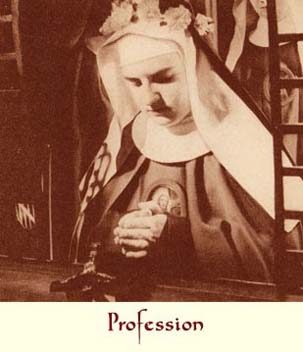
She met in Austria, Eugenie Gauvenet, the future Mother Marie Alphonse of the Will of God, penitent of Ven. Fr. Passerat, and joined her in the projected Redemptoristine Foundation. In order, like Mother Marie Alphonse, to drink of the spirit of the institute at its source, the two were sent by Fr Passerat to the Redemptenstine Convent at St-Agatha-of-the-Goths in Italy to make their novitiate. After having received the religious habit at Rome and having venerated the Sanctuary of Loretto, they returned to Vienna.

They made their perpetual vows and set about the foundation of the Redemptoristines over the Alps. Later Mother Maria-Anna-Josepha had the joy of welcoming the youngest of her 8 children within the walls of her monastery in Vienna. She fell asleep peacefully in the Lord on 25 February, 1841. †

(Translated from "Memorial Alphonsien" and typed with thanks to Mrs Trisha Jones.)

Mother Marie-Alphonse of the Most Blessed Sacrament, O.SS.R. (1913)

Who died in the odour of sanctity at the Monastery of St Alphonsus in Malines (Flanders) on 12 December, 1913.

Prevented from her most tender youth by choice graces, the venerated Mother Marie-Alphonse radiated above all her great purity and simplicity which became in her the principal of the admirable gift of piety which is to be found throughout her life. God, the Church, her Order, souls, were there unchanging objects of her love. As superior for 25 years she edified all by her perfect regularity, her maternal devotion and her angelic recollection. As spouse of the Divine Redeemer, called like Him to ascend the steep heights of Calvary, God wished to mark her with the Royal Seal of the Cross. She passed the last 12 years of her life upon a bed of sickness. Always smiling, she put up with her cruel sufferings with an heroic patience, until the day when, attaining her Divine Ideal, she expired – a veritable holocaust, consumed in the furnace of pain, in order to go, we are confident, to enjoy her Eternity for unending ages.†
(From Mother’s mortuary card.)

The Servant of God Mother Marie Celeste of the Will of God, O.SS.R. (1875-1922)

We here present a longer and more substantial life of this holy Redemptoristine Nun.

Chapter I
Birth, Girlhood and Vocation


In one short sentence Our Lord summed up for us the whole scope and meaning of his life on earth: "I am come to do the will of him who sent me."

In these few words He has traced for us the most complete and most accurate portrait of each and all of the saints, whether they be the martyrs of the early Church watering the earth with their blood that the seed of the Word of God might spring up amid the ruins of a decayed civilisation; or the wonder-workers of the Middle Ages, raising their voices above the clash and din of warfare, and startling men by the very force of their miraculous powers; or the gentler race of men, such as St Francis de Sales or St Alphonsus Liguori, combating error by the milder weapons of their pens and persuasive eloquence, none has ever done other than the will of Him who sent them. But times change, and in each varying scene of the world, sanctity, like everything else, has donned a different outward garb.

When the great French Revolution swept away nearly all the old landmarks, the generation of saints who arose, seemingly from the very force of that mighty social earthquake, differed widely from the saints of old, not, indeed, in their essential holiness, but in its outward expression and the setting amidst which their sanctity was worked out.

They were no longer men set apart from their fellows, marked by unmistakable signs and tokens; they lay, as it were, hidden, the leaven leavening the mass. In most cases it was death alone that drew back the curtain that hid their virtues from an indifferent or scoffing world. To few was it given to attain a world-wide reputation like the Curé d Ars; but who shall count the number of hidden lives, already crowned by the Church, or about to be so honoured?

Such was the life of Sister Marie Celeste of the Will of God, whose years on earth were passed in the seclusion of her own home, or the still more restricted solitude of the cloister. But the fact that since her death God seems to be making known His Will, by evident signs, that he wishes her to emerge from her hiddenness, has made it appear desirable that the doors of the cloister that sheltered her should be opened, and that the varying scenes of her life therein should be shown as an encouragement to those, both within and without the walls of the convent, who have to live an ordinary life amidst more than ordinary trials and contradictions.

Most lives of cloistered nuns seem of little if any help to others, for the grille is kept hermetically sealed after as before their death, and a very distorted picture of the soul's pilgrimage is all that is given, from the very fact that it is merely a series of vignettes on a colourless background, with no discernible surroundings. For this reason we have determined to take our readers in spirit behind the grilles, and to show them Sister Marie Celeste as she lived and moved amongst her Sisters, and the scenes amidst which she worked out her salvation, and, incidentally, her sanctification. There may be shadows as well as sunshine; there are both in every true picture. Only in heaven shall we have the true land where it is always afternoon.

In the Gospels themselves we have side by side the portrait of the wholly perfect Man-God, and the first apostate priest, his own friend. The visible presence of the Light of the world did not produce a shadowless picture. The cockle is to be allowed to grow with the wheat. Why should we pretend that there is no such thing as a weed? No matter how deep the shadows in any living picture, even before the end, the sunshine will creep in and absorb the darkness. Half-truths are nowhere so unconvincing as in a biography, and any attempt to paint a picture of even a short life, leaving out the shadow of the Cross, will surely be a failure.

Sister Marie Celeste, Marie-Jeanne van Eeckhoudt, was born on August 7, 1875, at Brussels, and found an elder sister Mathilde and an elder brother Jules waiting to receive her in the old house in the Rue Haute, where her parents had a large stationery business.

John Baptist van Eeckhoudt and his wife Catherine Kebers belonged to old and highly respected bourgeois families. Two of little Marie's maternal uncles were distinguished public servants; one was a well-known lawyer, and the other the director of customs, and during the world-war did good service for his country as Director-General of Finance. Several of her cousins have risen high in the professions of engineering and medicine. But above and beyond all worldly honour and advancement, Monsieur and Madame Eeckhoudt prized their century-old devotion and service to the Church, and their one desire was to see their children carrying on the same honourable traditions. In the bringing up of their young family Catherine seems to have stressed the sterner views of life, while we find the good-natured John Baptist, sometimes even surreptitiously, providing games and innocent amusements for the little ones, whose daily round included not a few pious exercises.

In his youth M. Van Eeckhoudt had dreamed dreams, which he confided to the good Curé, whose delight he was by the piety and the devotion with which he served at the altar, and between them they succeeded in getting permission for little John to begin studying art in the studio of a well-known painter. But alas! The death, within a short time of each other, of his protector and the artist shattered his dreams, and he was obliged to return to his father's house, and to take his place in the business which was to be his inheritance; but he never lost the debonair manner which he had acquired by his short-lived experience of a mild Bohemia.

Later on he loved to take his children out on Sundays or holidays, and to show them the many beautiful objects of art in Brussels, and to teach them how to know and love everything beautiful. To Mathilde and Jules all this was sheer joy, but little Marie did not share her father's tastes, and said frankly more than once, "Thank you, papa; I like much better staying with mamma."

The children might well have been spoiled if the calm, stolid figure of Madame had not been there to counteract any such tendency on the part of her husband. Not that she was a hard woman, far from it, but she did not know such a word as disobedience, and to her duty summed up each hour of the day. What she lacked in imagination and intellectual gifts she made up for in sound common sense.

We have only to look at the photograph of little Marie, aged eight, or, again, as we see her at twelve years old, to be able to analyse her mother's character to a nicety. Strong, sensible stuff clothes, made without a frill or furbelow; thick woolen stockings, and uncompromisingly solid lace boots; the hair drawn straight back from a wonderfully beautiful forehead - all proclaim the sensible, hard-working mother, who loved her children most sincerely, but had no time to spend on trimmings.

She was a woman of very deep feelings, and the love of her life was her little Marie; but she did not spoil her, and expected her to obey without demur, and when the little girl, as not infrequently happened, we are told, was inclined to sulk, her mother's surprised tone as she said, "Well, Marie, are you going to sulk over such a trifle?" soon brought the smiles back, and sunshine once more reigned.

Perhaps the person who brought most joy into the lives of the children at this time was the old grandmother, Madame Kebers; and it gives a very charming touch to the family picture to be told by Mathilde that Grandmamma always understood that Jules wanted plenty of space to kick his feet about in, even in the parlour, and would never allow him to be suppressed.

Madame van Eeckhoudt was, however, a little jealous of the children's love for the old lady, and if the visits were prolonged too much she sent to call them home, especially the little Marie, whom she could not bear out of her sight.

If their mother was somewhat austere in her views concerning their bringing up, she was the first to give the children the example of what she taught. Long before anyone else in the house was astir she was on her way to daily Mass, and only on her return did she wake her little ones, and hear them say their prayers.

The prayers were evidently said opposite a statue or picture of the Child Jesus crowned with flowers; for one of the three tells us that the first prayer they learned, and which have ever since recited, was, "Little Jesus, crowned with flowers, come into my heart and stay there."

Little Marie seems to have profited well by her mother's example and teaching. We are told that very early she began to make great efforts to overcome her naturally impetuous and quick temper, so that the outbursts became less frequent, and never degenerated into real quarrels with her sister and brother, who both loved her very much, and very soon began to give way before her more virile and decided character. It says much for the amiability of her nature that neither of them showed the least jealousy of the decided partiality shown by their mother for her.

Madame van Eeckhoudt early accustomed her children to take their part in all household duties, and encouraged them to make clothes for the poor and themselves, and even sent them occasionally to serve in the shop, in order to teach them good manners and politeness in dealing with others. But she did not encourage them to make friends outside their own family circle, and they visited no houses except those of their relations. Marie and her sister were sent to the excellent school kept by the Sisters of Charity, in the Rue de Poincon, and, in 1892, Marie passed with honours the Government examination in music, domestic economy, and free-hand drawing. Music was always her favourite study, and it was the delight of her father and old grandmother to hear her play or sing, for she had a really beautiful voice.

Study had never any attractions for her, and she often expressed her astonishment at the interest her sister found in books of travel, and, indeed, in all kinds of reading. She never had more than one prayer book, so that already, as a child, she was evidently drawn to the more contemplative way of prayer. She seems always to have been silent and reserved, somewhat of a dreamer we are told, but very amiable and thoughtful for others. The home in the Rue Haute seems to have been a very happy one, and though to modern children it would have been singularly devoid of amusements, perhaps the little van Eeckhoudts enjoyed the yearly treat of the Akermesse, or fair of Brussels all the more from its being such a rarity. Marie took her full share of riding on the roundabouts, and of the various other amusements.

So her happy childhood wore on, and her tenth year dawned, which was to bring with it one of the most important days of her life, her first Communion. Sister Mary Edward, the Mistress of School, set herself to prepare her dear "Mariekin" for this great event. Marie, on her side, redoubled her fervour by placing herself more particularly than ever under the protection of her heavenly Mother and her chosen protector, St Joseph.

With her admission into the class of first communicants, Marie set herself more earnestly than ever to correct her faults, especially her quick temper and her wilfulness, which it had always been the aim of her mother to overcome. When she was still a little child, her brother and sister experienced what one of them expressed naively: "When Marie says 'I will,' the thing must be done." Now, however, we find the little girl gaining more and more the mastery over herself, and winning the love and esteem both of her mistresses and her companions, so that she left a lasting impression on them of a singularly lovable and amiable character, always ready to give in to others and to help them in every way.

According to the prevailing custom in Belgium, Marie made her first Communion on Passion Sunday, April 11, 1886, in her parish church of Notre Dame de la Chapelle. Few details remain to us about this day, of which Marie later on said, "Oh! That was indeed a day of heaven for me."

One of the curates of the church, a very holy priest, said to Madame van Eeckhoudt: "Madame, your little Marie is a saint. When I saw her coming back from the Holy Table I could not take my eyes off her, for I have never seen such an expression on the face of a child. It was that of an angel adoring the Divine Majesty." It was perhaps at that moment that the little girl was listening to the call to follow the Lamb, which, we know from her own lips, resounded in her heart that day for the first time.

In spite of her great piety and eagerness in the performance of her religious exercises, Marie was not at all a goody-goody child. She loved games, and was the first at recreation to take the lead in any amusement, and entered into the spirit of them with her whole heart. What did astonish her companions was that she, who was the life and soul of the game, should on a sudden, at the first stroke of the bell, lay aside the ball, or other plaything, and become at once the staid little girl, whose one preoccupation in life seemed to be the stocking she was mending, or the exercise that had to be carefully written. Marie was already following in her mother's footsteps and learning to place duty before everything else. Even so early she had acquired the habit of knowing no hesitation when the call of obedience summoned her.

A short time after Marie's first Communion the happy home in the Rue Haute was visited by much trouble and anxiety. The business was rapidly declining, and in order to keep pace with the times a whole new plant would have to be introduced, an expense which the worthy proprietors could not face. There seemed nothing to be done but to give up the whole concern, and try and regain part of their losses in a much humbler way of business. It was with bitter sorrow that the poor mother faced the prospect of selling the home, in which all her married life had been spent, and where her dearly loved children had come to add fresh joy to her life. She shared her sorrow with her eldest daughter, Mathilde, then little more than a child herself, and together they wept and prayed. "Let us pray harder, mother," the girl said after one particularly trying day; "and we will get Marie to pray with us." Madame was almost beside herself at the thought that, young as they were, she might be forced to send her children out to earn their own livelihood, but at the mention of her dearly loved Marie her courage returned. She answered quickly, "No, no; say not a word to her; I forbid you; let her remain happy." All her mother's heart went out to shield the baby from too early a sorrow.

Happily, prayer succeeded when all human efforts had failed; an unexpected turn in the tide of fortune put the business again on its feet, and the happy life continued as before. Marie became more and more the sunbeam in the old house, and each day Madame van Eeckhoudt depended more and more on her, especially when, at the age of seventeen, she left the school, and took her place as her mother's right hand in all household affairs. For this she was well qualified, for she had gained her diploma, with honours, for domestic economy. It was in the year 1892 that Marie came home for good. Her mother's health was beginning to fail; doubtless she herself felt already the first beginnings of the fatal malady that was so soon to carry her off. Marie was all in all to her, but even she could not stay the progress of the dreadful cancer, and, in 1894, Madame van Eeckhoudt died after a painful operation, from which she never recovered.

Of a less virile and more emotional temperament than his wife, Monsieur van Eeckhoudt sank under the sorrow that made his house desolate, despite the love and affection of his children, whom he adored. He never seems to have recovered sufficient strength or courage to apply himself seriously to business again, and the home was more or less broken up. Jules entered another firm, and Marie went to live with her grandmother, Madame Kebers, and her two aunts who had a flourishing drapery house at the other side of Brussels.

Foreseeing her own death, and knowing what would then happen, Madame van Eeckhoudt had already sent Marie to learn business with these good ladies. She had acquired great proficiency in book-keeping and the management of affairs, but she came home every evening, and one of the few joys remaining to her relations was her music. As soon as the evening meal was finished, Marie seated herself at the piano, and the sound of her lovely voice, for some few hours at least, drove sorrow away from those she loved. At her mother's death, however, Marie went to live entirely at her grandmother's, only returning on Sundays to spend the day with her father and Mathilde.

To her aunts this arrangement was a sheer joy; their niece had become almost indispensable to them, and they welcomed her most cordially, as did her grandmother, whose favourite she had always been. To the young girl herself, however, it was a sad life; she felt keenly her mother's death and the separation from her father, feeling his sacrifice almost more than that entailed on herself. Above all, she missed the old quiet home life, where she had been accustomed to so much liberty for the performance of her religious duties, and where she was able to indulge her love of solitude and silence.

Now, of necessity, she was from morning till night in the shop, where her winning manners and bright happy smile attracted many customers, and the business increased wonderfully. The very way she bowed to acquaintances in the street made them eager to see her again, and many came to buy who were drawn there by the charm of the niece rather than by the goods of the aunts.

In order to secure her daily Mass and Communion, Marie had to rise very early, and a friend of those days tells us how each morning, sometimes even before daylight in winter, she used to see the young girl hurrying along to the Church of the Madeleine, either alone or accompanied by a servant with whom she had already been to the market for the household provisions. It was at the Madeleine that Marie first became acquainted with the Redemptorist Fathers, one of whom especially was to have so much influence on her and her future life.

Old Madame Kebers was nearly at the end of her long life, and Marie devoted herself particularly to cheering the lonely hours of the old lady and to mending her gloves, for it had become a joke in the family how she was continually wearing out her gloves. One day Marie said to her laughingly, "Grandmother, I know how you wear out so many gloves; it is because you are saying your rosary from morning till night, in the streets as well as the long time you stay in church." The grandmother flushed very red, saying, "Well, say nothing to the others; I will go on saying the Aves and pray for you, and do you go on stopping the holes."

To her grandmother also Marie's music was a great solace, as it was to an old aunt, a sister of Monsieur van Eeckhoudt's, whom she often visited. Though not really old, this aunt was quite blind, and her life was very desolate; the visits of her niece became her one joy, and she seemed to spend her whole time listening for Marie's step upon the stair.

In 1900 the second big sorrow of her life came to Marie; her father died. Though perhaps the void made by his loss was not so great as that when her mother was taken from her, yet she felt the loss keenly, and, as in the former case, her grief was all the more profound that it was the more undemonstrative.

Her sister tells us that up till now Marie had said little or nothing about her religious vocation, knowing how much pain her decision would cause her parents. On her declaring her intention at the time of her mother's death, her aunts had vigorously combated the suggestion and she had much to suffer in consequence.

Still more alone when the house in the Rue Haute was finally given up, she again made known her intention, and her resolution was backed by the authority of her director, Father Strybol, C.SS.R., who stood high in the opinion of all Brussels for his sanctity and rectitude of judgement. All was to no purpose, and Marie had still many a bad quarter of an hour to pass through before she could spread her wings and fly away to the desert.

In 1899 Mathilde van Eeckhoudt married, and not long after her brother-in-law wished to make the ties between the two families still stronger by himself marrying Marie, and for this purpose he sought the mediation of her sister; but more forcibly than ever she declared her intention of never having any other spouse than a Heavenly one. She waited and prayed, and showed her aunts more deference and amiability than ever, and at last even they became convinced that it was useless any longer to thwart her desires. Yet it was not without much pain and many regrets that they at last gave way before the persuasion of Marie's director, and gave their consent to the niece's entering a convent.

Unknown to them, she had already four years previously paid a hurried visit to the home of her choice; this was the convent of the Redemptoristines at Malines. A friend of Marie's tells us that she had for some years marked her separation from the world by dressing herself like a servant. This can have been no small mortification for a young, sensitive girl in a stylish capital like Brussels.

At last, on February 18, 1900, Marie, accompanied by her Aunt Bertha, set out for the promised land, where two other young ladies were to join her and together start on the road of religious life. So great was the young girl's joy at arriving at her destination that her aunt was quite overcome at the thought of how by every means, gentle and otherwise, they had tried to hinder the achievement of this object. "Oh, Marie!" she exclaimed, "we did behave badly; if I had to live this time again I would behave very differently."

Marie always entertained great affection for her aunts, especially Mlle. Bertha, and never, even to the one who was the confidante of her most intimate thoughts, did she ever complain or cast any reflection on the two ladies. †

  © Blogger templates The Professional Template by Ourblogtemplates.com 2008

Back to TOP